Showing posts with label special needs. Show all posts

Friday, April 1, 2011

Autism Awareness. What does that even mean?

April is Autism Awareness Month.

But what does that really mean?

Because, if your life is not affected by kids or adults with autism, are you aware?  Do you need to be aware?  What do you need awareness of?  Are you even interested in being aware?

Instead of quoting the facts from a book or web site (which, if you're reading my blog, you could probably quote word for word anyway), I plan to give some personal autism awareness facts...

1. Kids with autism are lovable.  Daily, I see a little girl with autism who smiles, giggles, and hugs me. Sure, a handful of her hugs are meant to cause "deep pressure," but the other handful, pure affection.  She calls school "Miss Kolis school" to differentiate it from "summer school" or "dance school."  When given the sentence "My best friend is... " she says "Miss Kolis."  She is the most lovable little girl I have ever known.

2. People with autism can communicate.  Just because someone cannot use their vocal chords to speak to you does not mean they don't communicate.  Gestures, facial expressions, body language, and hand movements have never been so powerful!  And the day that one of my students used both a Dynavox Xpress and an iPad to tell me that using the Dynavox Xpress made him "sad' and using the iPad made him "happy," language had never meant so much. (No disrespect to Dynavox, another one of our students loves his Xpress!)

3. People with autism are ALL different.  In the 8 years I have been a special ed. teacher, I have spent nearly 4 years working with students with moderate-intensive special needs.  And in those 4 years, I've worked with 6 kids with autism.  NOT ONE of them is similar.  NOT ONE of them learns the same way.  NOT ONE of them uses the same ways to communicate, nor has the same sensory needs.  EVERY PERSON with autism is so unique.  And we value their individuality every day.

4. People with autism are true to themselves. I have never known a person with autism to feel embarrassed or really to give a hoot what other people think of them. One student with autism loves to eat raw onions.  He doesn't worry about his breath or the fact that other people think its a little unappetizing to see him eat raw red onions.  One of my students with autism needs to see the pictures in the book or the icons on the schedule. And when he can't see, he gets up and gets closer, takes a look, and then returns to his seat.  He helps himself without caring what the others may think.  And, while I understand that we work on social skills and therapies, etc., etc., I admire the sense of self that I believe my students with autism have.

5.  People with autism can learn!  In the four years I've been privileged to work with kids with autism, every single one of them has been able to learn and grow more than I could have ever imagined! And when people ask "Can that kid really learn?"  I can respond with "Yes, he learns. And he's had to learn about 3 times more than the typical kids have.  He's learned what numbers are, how to count with them, and how to add.  He's learned every step to wash his hands when other kids just knew how.  He's learned to control his impulses when a teacher asks him to sit in his chair.  He's learned to read your facial expressions. And he's learned to walk in the hall with his class.  And on top of all that, he's also understanding chapter books and learning to type."  OF COURSE HE LEARNS!

6. Our classroom loves kids with autism AND kids with all types of abilities and disabilities!  Whether it's Autism Awareness Month, World Down Syndrome Day, or the celebration of any diversity, ALL kids are welcome in our classroom.  If you need to stand to do your work, come on in.  If you need to run 8 feet every 20 minutes, come in.  If you need to vocalize in the middle of a picture book being read aloud, come in.  If you like to eat only the chocolate chips out of a chocolate chip cookie, or only eat yogurt at school, or eat only white foods, come in.  If you need to swing in between subject areas, or jump on a trampoline, come in.  If you use an augmentative assistive communication device, you are welcome.  If you like to color the tree purple and black instead of green and brown, we want you.  If you say "5 school" instead of Friday, come in.  If you smile and clap over your head every time you are able to feed yourself with a spoon, big claps to you, come in!  If you can comprehend a chapter book given additional visuals, learn to add using touch points, and love Dora, Clifford, Barney, Mr. Rogers, Piggie and Elephant, Winnie the Pooh, Diego, Word World, Arthur, the Princesses, Thomas the Tank Engine, or Elmo, our room is the place for you.

So, April is Autism Awareness Month.  And in Room 5 at Hilton School, we want you to be aware that, if you don't know and love someone with autism, you are really missing out!

Saturday, January 8, 2011

The Debate over iPads in Education

This week (specifically on Jan. 4th, 2011), the NY Times came out with an article embracing the iPad called “Math Moves: Schools Embrace the iPad.”
 
Most quotable and applicable to our Room 5 needs in this article was this statement by the author, “school leaders say the iPad is not just a cool new toy but rather a powerful and versatile tool with a multitude of applications, including thousands with educational uses.”

Immediately following, “A Pointed Response to the NYT Article on iPads in Schools” was posted by the Humanities, Arts, Science, and Technology Advanced Collaboratory.

This response began by stating that “if you change the technology but not the method of learning, then you are throwing bad money after bad practice... The downside is that it is not a classroom learning tool unless you restructure the classroom.   By that I mean, there is no benefit in giving kids iPads in school if you don’t change school.”

Sure. Points taken.  iPads are incredible, but are toys if not used properly… But ARE THEY?

In Room 5, we are currently using the iPads (that we received with a generous grant from the BBH Schools Foundation) in many different ways and for many different reasons.

If you’ve been following along, you know that Room 5 individualizes for every student.  So, its easy to say that every one of my 8 students has already used the iPad with a different purpose.

Here are some of the ways we’ve used the iPad:
1. A student with autism who is fully included in the “regular” classroom got upset in class.  He came to Room 5 for some cool off time.  As he jumped on the trampoline, he continued to cry.  I lured him to the table with the iPad and started to play Toy Story 3 Memory with him.  10 minutes later, he was ready to go back to class.  In those 10 minutes, I engaged this student with autism in turn taking, practicing the words ‘my turn’ and ‘your turn,’ and in tons of language as we named the characters from Toy Story 3 and used social game playing language such as “good job” and “way to go.”

2. A student with both autism and Down syndrome is pretty difficult to motivate sometimes.  A simple photo of the iPad in a “First-Then” schedule helps.  This student knows, “First I do my work, Then I get the iPad.”  Without the promise of the iPad, we got maybe 3 sight words receptively identified  in a 15 minute time period.  With the iPad yesterday, we got 40 words receptively identified in a 15 min. time period.  15 minutes of work then 5 minutes on the iPad where fun and musical programs are work in disguise!

3. I sit next to the student using the iPad.  It happens, but infrequently, that I leave a student alone with the iPad.  I sit next to them, prompting for language and other skills.  ALL of my students need practice with more social language and more vocabulary.  The iPad is helping with that.

4.  A student with autism who is nonverbal but loves to type and spells many things correctly or phonetically is currently using the iPad as a communication device with the App called “Speak It”.  While the iPad costs $499 (give or take the cost of the communication App you want), another communication device from a company like PRC might cost close to $7400!  I could buy 14 iPads for the cost of one Vantage Lite.  (Sure, there are arguments to be made here about durability, customization, etc. and we recognize that. )

5.   Multi-modal teaching.  As a special educator, I know that I need to teach using all of the multiple intelligences and all of the modalities (visual, auditory, tactile, etc., etc.).  The iPad is just one more tool in our arsenal of strategies.  Here’s an example: With my Kindergarten students, we are currently working on ‘beginning sounds.’  First, we look at objects that all start with one sound.  These are fun little toys and we name each of them verbally and feel and touch each object, then trace the beginning letter with our finger and make the sound.  Next, we look at pictures of objects to practice beginning sounds.  The pictures are first paired with the written word, then appear just as picture icons.  We practice saying the word and making the beginning sound.  Next, we move on to 3 or 4 pictures and point to the picture that starts with the verbally given sound.  THEN, we can introduce Apps on the iPad like “Word Magic.”  Word Magic shows a picture and the remaining letters of the word and asks the user to receptively touch the correct beginning letter out of a choice of 4.  It even provides it’s own positive reinforcer if the user answers correctly and says things like “Try again” if the user guesses wrong.  It ALSO gives a score on the side saying how many the user got correct on the first try and how many were incorrect.  Hello data collection!  Just in beginning sounds lessons alone, we’ve reached the auditory learner, the visual learner, the kinesthetic learner, the intrapersonal learner, the 21st Century learner!


5. Apps that promote more language AND are motivational are exactly what we look for in any “tool” or “strategy” in special education.  Apps like “Sentence Builder” and “Monkey Preschool Lunchbox” do just that.  (I’ll be writing a post about the Apps that we commonly use most in Room 5 soon.)
Now.  You might be thinking that I am using expensive toys to motivate my students.  You might be thinking that I could do the same with the computers we already have, a musical keyboard, an exciting new book, or even the promise of recess (that costs nothing at all).  And sure, you may be right.  (Although eventually we hope to get into more advanced uses of the iPad like blogging and tweeting from different school locations and reading chapter books in Apps like “Kindle for iPad.”)

But, consider this.  My students, those with moderate to intensive disabilities, are living in a world where they will constantly be struggling to compensate for their difficulties and come up with new strategies to deal with life’s challenges.

Aside from the fine motor, decoding, encoding, math computation, math reasoning, musical, and art skills that they can acquire from the iPad and it’s Apps, why not arm them with more “21st Century Skills?”
The tech world and society are moving towards the “touch screen,” scrolling pages, hand held devices, social media, and digital literacy.  Why not move ALL our students along as well?

The possibilities here are endless.

And we’ll keep writing about them and sharing our experiences.


OUR possibilities are endless.

Tuesday, December 14, 2010

Apps That are Right for Us!

We've had the iPads for one full week now and have had some time to review some Apps.

Here is the beginning of a list of Apps that are right for us (kids with mild-moderate-intensive special needs, grades k-3):
Cookie Doodle

1. Cookie Doodle- AWESOME!  You choose your cookie and get to "measure" the ingredients, mix, bake, and decorate your own cookies.  Great for following directions, making choices, positional concepts, color identification, shapes, and FUN!  We love this and plan to use it year round!

Word Magic
2. Word Magic- Look at the visual image, and choose the beginning sound from 4 letters. Choose beginning sounds, medial sounds, or ending sounds.  This App keeps track of correct and incorrect responses for easy data collection.
My Very First App

3. My Very First App- This is in the Eric Carle style and uses his illustrations to, first, match pictures with colors and color words.  Next, play a simple game of memory with the same illustrations.  Each illustration is named aloud as it is turned over pairing auditory and visual learning.  Change the memory game from "easy" to "medium" to "hard."
Alphabet Tracing

 4. Alphabet Tracing- For each letter, a train, caterpillar, or animal models the direction in which to write the letter; no pencil or stylus needed.
Telling Time App

5. Telling Time App- Uses a real watch and gives four choices to receptively tell the time.  This could provide an alternative to our traditional file folder tasks.
ABC- Magnetic Alphabet

6. ABC- Magnetic Alphabet- It's a magnet board on the iPad.  Digital letter magnets are movable and allow you to easily make words.

7. Speak it! Text to Speech- We are going to trial this as a communication device for one student who wants to type everything.  Simply type and touch "speak it."  This App has four choices of "voice" and has the ability to save frequently used words, phrases, or sentences. Imagine carrying an iPad or an iPhone rather than a $7400 speech device??? 
Monkey Preschool Lunchbox

8. Monkey Preschool Lunchbox- Great for listening and receptive language!  Each question in the "game" asks for a different concept.  Examples- "Which fruit is different?"  "Point to the food that is a fruit."  "Which word begins with the letter C?"
Thomas Game Pack

9. Thomas Game Pack- Nothing seems to motivate more than Thomas the Tank Engine.  This game pack offers 3 different games- Memory, Puzzles, and Navigating the Train Tracks.  I can't barely pry their fingers away from Thomas.

10. Sentence Builder- This App offers a visual and choices in how to build a sentence that appropriately fits the picture.  Great for receptive language, modeling appropriate parts of speech, and modeling complete sentence structure. 

Sunday, November 14, 2010

5 Reasons I Love This Job THIS WEEK.

It's no secret, I had a rough week.  The special ed. coordinator found me in the hallway and gave me a hug (for goodness sake!).

But, inspired by a great blog, What Ed Said and the blogger's series of 10 Things, I'd like to make a list of:

5 Reasons I Love My Job as a Special Educator THIS WEEK!

1. Music Therapy.  This week, I plopped myself down in our Music Therapy session for 30 minutes, I saw 7 little bodies completely engaged, following directions, and excited about what would come next.  It's amazing what a little music can do.


2. The unfiltered voices of my students.  The fact that my students say aloud what the rest of the world is thinking is something that we work to make socially appropriate.  But, there are so many times that the unfiltered comments of my students and my strange sense of humor go hand in hand... like on Tuesday when I was prompting a student to fill in a graphic organizer about this bird he had made.

"What do you want to name him?" I said.

"Pee pee" my student answered.

Yep, this student would.

And while I politely explained to him that this bird would be hanging in the hallway near his homeroom and although it might seem really funny to name him Pee Pee, his homeroom teacher AND his mother might not find it so funny.

And then I turned my head and laughed. Hard. Because a bird named Pee pee?  That's funny.

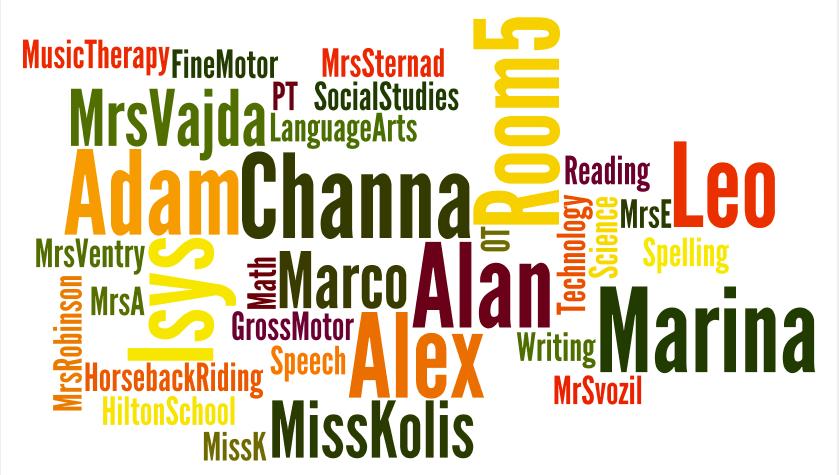
3.  This week, I taught 3 third graders, 1 second grader, and a Kindergartener with autism, cognitive disabilities, and other assorted genetic disorders how to use the website Wordle.  I thought this would be a fun way to play with words and help us make them more visual.  I used some resources like 46 (now 48) Interesting Ways to Use Wordle in Your Classroom and away we went.  We made locker tags and spelling word clouds and fun posters for our 21st Century learners bulletin board and, Who was the Most Engaged?  My non-verbal Kindergartener with autism.  Coolest.  Kid.  Ever.

4.  On Friday when it seemed there was a gray cloud hanging over Hilton School (although the sun was shining brightly on the sunny West Side), my principal walked into my classroom around 2pm.

This is not uncommon as he does walk throughs regularly and sometimes comes in to discuss things with me during the day.  He looked slightly disheveled as I asked "What's up?"  (Yes, we are pretty comfortable in Room 5 with our regular visitors.)

"Can I please work with one of your students Miss Kolis?"

Um, okay.

Turns out, boss was having a hard day too.  And, where did he come for happiness?  ROOM 5!!!  Our Room!  Our room inspires happiness!

And as I sent him to the reading carpet with a third grader, I kept an ear out to see how it was going.  Every other page of that Arthur book, my little sweetie looked up at him and said "You da best pwincipal." 

Needless to say, he left with a smile.

And last, but certainly NOT least...

5.  While making a Wordle about a third grade student, she needed some prompts to answer questions about herself so that we could type the words in.  I would start the sentence and she would finish it.  "Susie likes to eat..."   "... cupcakes."  "Susie likes to eat cupcakes and... "  "...cookies."  "Susie likes to read about..."  "... Dora."  "Susie lives in..."  "... Broadview Heights."  "Susie's best friend is... "  "... Miss Kolis."

Wait.  Really?  That was so awesome!  She said I was her best friend.  That was the cutest thing I have ever heard!  Here's my third grader who I push every single day to work, work, work.  Math, reading, writing, spelling, appropriate social skills, and no you may not sit on my lap anymore because when you go to 4th grade, they will think I am crazy for that.... and you said I'm your best friend.  I.  love.  you.


I love this job.

Thursday, August 12, 2010

Setting Up Our Classroom- What Does Your Space Look Like?

As I've been setting up our classroom this past week, I've been trying to decipher what the most important aspects of a classroom for students with special needs are.  I suppose it depends on who you talk to.  If you run a strict ABA program, you probably have more one to one teacher table set ups in your classroom.  If you run a DIR Floortime program, you likely have much more space and place more of an emphasis on your play or leisure time area.  I run something called the "Blended Model Method" which includes some ABA aspects, some DIR Floortime aspects, mostly TEACCH based and Sensory Integration driven.  Plus, I throw in the curriculum (or the more appropriate, "standards"), some functional skill work, and social skills. (You can click here for some of the other programs we use.)

Mash all those things up and hope for...

...A student who is able to read, count coins, add, subtract, use the computer for more than just playing PBSKids, respond appropriately in social settings, share toys with friends, and monitor his/her own sensory needs in ANY setting.  Hope for generalization (before 4th grade).

So, what in the world should this classroom look like?

Well, we need a "one to one teacher table" and an "independent work station", of course.  One to one teacher table is where most of my instruction takes place.  I instruct the skills in the content standards at the one to one teacher table.  Then, once those skills are mastered, we move them to the independent work station.  We have one of each, for 7 students. In both one to one teacher table and independent work station, students master activities like shoebox tasks and file folder games.  Here is our shelf of homemade shoebox tasks (as you may be able to see, some are numbered, some aren't.  That was our first attempt at organization in the first year we opened this classroom).


Next, I've attempted to make 3 small group areas this year.  Because our students have been so inundated with one to one therapy, they are not used to working in small groups.  We can also do one to one teacher time on the carpet in a more unstructured space. I believe we need more small groups and more time for problem solving.  Here's one space for that.


We'll use this small group area daily for circle time and calendar skills.  This is the only "cutesy" bulletin board we have, but I believe it's useful as well.  I believe in making the room useful and meaningful to students, not just cluttered with cute.

We, then of course, have to merge my passion for technology with kids with special needs and throw in our computer area.  Because of a grant I wrote 2 years ago, and some foraging, we will have 7 computers in our classroom this year.  That's right, 7.  I will see 7 students, and we have 7 computers.  That, in a word, is awesomeness.  We'll be starting e-portfolios using weebly.com this year! We also have a SMARTboard, Leap pads, Leapsters, a Touch Screen, BoardMaker Activity Pads, etc.
Think we've used up all our space yet?  No way.  We still need a gross motor area, right? 
We also have a ball pit back there, but the swing needs to be removed to use it.  A sand table completes that corner, only because there was no other area for it.  Then, there's our new sensory table.  We're starting off with bird seed on one side and feathers on the other.  I can't wait to see who will make the connection first.

Next, I needed to make sure I had space for each of the 7 students' visual schedules.  A visual schedule is set up for each student each day indicating what will come next.  A visual schedule might have picture icons (we use BoardMaker Plus v.6) to show Circle Time, computer, bathroom, wash hands, read book, Music Class. (In place of picture icons, you could also use an object schedule, photo schedule, or word schedule, depending on the students' level.) Students remove the icons as they finish and place them in the plastic envelope below the schedule.  At the end of the schedule, our day is done (depending on how many icons the student can handle).  Here is an example of an empty visual schedule.  This student's schedule has Legos because I know he loves to build with Lego blocks.
Lastly, I'm feeling a little guilty this year.  We have no play or leisure time area.  I just don't have the room.  We have the toys, we have the games and the puzzles and the strategies to teach kids how to play, but I will have to be really disciplined and structured when we have a leisure time.  We"ll have to give limited choices ("Please choose puzzles or Play-Doh today").  I'll have to make room in our small group areas.

Of course, we'll make it work.  I am thankful to have a classroom (and not a closet).  I am thankful to have a job.  I am thankful that we have the amount of materials and games and puzzles... I am thankful that not one of these students is "self-contained" because we have managed to get them each included at some point during the school day (because they can be, and because they can be successful).

Now, just in case I missed something...

Are there other areas that you would include?  What's your rationale?  What would you do with the other bulletin boards in the room?  Do you have questions about our space?  Your space?  Can I help?

Sunday, July 18, 2010

LABELS, be gone...

Recently in our community, I've heard there's been some talk about my classroom.

Let me explain.

When I say "my classroom," I always feel that those words encompass many many things. "My classroom" signifies myself, 6 special education aides that come and go throughout the school day, an SLP who also has her own room, an OT and PT who come and go throughout the school week, a Music Therapist who visits once per week, ALL the strategies that the aides and I replicate when all of the therapists leave, along with functional skills to make life easier and academic content standards ranging from grades Pre-K through 3, depending on the student.  Mix all that in with my passion to integrate 21st Century Skills for kids with special needs and you get MY CLASSROOM.

Oh, did I mention that the kids in my classroom have autism, Down syndrome, genetic disorders like Prader-Willi and 2q37 Deletion Syndrome, hearing impairments, speech and language impairments, etc., etc., etc.?

Now, after saying all that, DOES IT REALLY MATTER WHAT MY CLASSROOM IS CALLED?

Well, I think it shouldn't...

But I keep hearing words like "Self Contained" and "MH Unit."  Other words being thrown around are "CD Unit" and "MD Kids."  "THAT Special Needs Program" and THE "special" program with finger quotes and all...

When I started teaching special education 7 years ago, I always referred to my classrooms as "classrooms" or "resource rooms."  And three years ago, when I began to teach kids with moderate to intensive needs, I knew there was some talk of a "unit."  I was unimpressed with this language and preferred to say "classroom."

I feel like we came to a compromise as a school building and our classroom is simply referred to now as "Room 5."  The teachers know what "Room 5" means.  And, if you have a student in Room 5, you know what it means.  Otherwise, you don't need to know about it.  If you ask, I can tell you what I do.  I teach kids with special needs and help other kids in the building who need interventions.  I teach in Room 5 down the hall. 

I suppose you could make the argument that one of the resource rooms should be "self contained" to be sure that your building is offering the continuum of services, right?  (The continuum of services in Ohio means the Least Restrictive Environment, or the place the child can succeed with the least supports.)  Well, in Room 5, we do offer the continuum.  I have a student who comes to me for only 50% of language arts and is included for the rest of the school day.  I have a student who comes to me for language arts and math, and is then included.  I have a student who comes to me for all instructional areas and is included for music, P.E., and media center.  WE OFFER THE NECESSARY SUPPORTS, so WHY LABEL IT?

I am so passionate about what I do.  I want so badly to help my students be integrated into their own "regular" classrooms (which we call "Room 11," "Room 22," and "Room 19").  

But, if people are still demanding terms like "self contained unit," are we really moving forward at all?

So, I'd like to encourage anyone reading this blog.  GET RID OF THE LABELS.  Call your classroom what it is, A CLASSROOM!  It's a learning environment like any other room in the building.  It's a resource room.  It's NOT A "UNIT."  It's NOT "SELF CONTAINED."

And put the child FIRST.  Don't say "the autistic girl."  Try "the girl with autism."  Don't say "That Downs boy."  Try "the boy with Down syndrome."  The child should come FIRST, not the disability.

Teach kids (ANY KIDS, ALL kids) to empower themselves with words.  "I am NOT a label.  I am NOT a disability.  I am a person FIRST.  And I learn in a CLASSROOM."

For us, it's Room 5. :)

Friday, July 2, 2010

July 4th Preparations for Kids with Special Needs

It's a Holiday Weekend, "Woooooo Hooooo!"  Right?

Maybe, It's a holiday weekend, "OH NO!"

Ever stopped to think what life might be like if you had a child with special needs during a holiday weekend?

What if your child thrived on routine, a sense of structure, a calm atmosphere, and/or a predictable social script for every situation?

Now, throw in a holiday, especially one like July 4th.  July 4th is all fireworks, parades, fire truck sirens, and polka bands, candy, and swimming, and outdoor grilling, new smells from the neighbors' backyards, and cars lining your ever so quiet little road.

Here are a few tips to set your child up for success and enjoy the "holiday:"

1. Social Stories.  Set your child up for success by sharing with him, far in advance, the plan for the holiday.  If possible, share the information in short, understandable sentences or phrases with simple visuals.  Read the social story every day leading up to the holiday.  Your child will be more comfortable with the forewarning.

2. Food Options.  The menu at the picnic is hot dogs and potato salad but your daughter eats only pizza or chicken nuggets.  Bring your own food.  Why stress out over the food menu when you can simply prepare what you know your child will already eat?  If your hosts are offended, they simply do not understand your world.

3.  Bring at least one or two comforting and familiar 'toys' or objects that your child favors.  Optimally, you've already forewarned him that there would be a trampoline, many kids, and lots of taking turns, but, maybe in the moment, it was a little overwhelming.  Comfort him without a scene, then try the trampoline again later.

4.  Don't force it.  Your child is different.  Different IS NOT BAD.  Different is NOT WRONG.  Don't force her to participate in any new activity that she is uncomfortable with today.  Today is already a hard day.

5.  Provide for sensory needs.  If you know that your child hates loud noises, bring ear plugs or head phones.  If you know that the smells of candy will drive her crazy, bring an "If-Then" board (If you watch parade, then you eat candy).

6.  Skip the Live Fireworks.  Did you know that you can watch a lovely fireworks show from Times Square ON TV???  Sometimes adults put way to much emphasis on this tradition when, in reality, it's a dangerous tradition that is scary to both typically developing children and those with special needs.

7.  Use a visual (or object or written) schedule.  Show the plan for the day.  "First car, then grandma's house, then parade, then candy, then chicken nuggets, then trampoline, then home."  Show when each "task" has been completed.

8.  If it's too stressful, treat the day like any other summer day.  You can "celebrate" the 4th in your heart, and skip the picnics, parades, and razzle dazzle.  If you don't miss it, they certainly won't.

Happy 4th of July to you, in whatever way you choose to "celebrate." :)

Thursday, June 24, 2010

10 Things Special Ed. Teachers Should Be Able To Do...

After reading the post What Teachers Should Be Able To Do on the "What Ed Said" blog tonight, I got to thinking...

If I made a list of 10 things that every special ed. teacher should be able to do, it would go something like this:

10. Write a legally defensible IEP using the IEP writing software provided by his/her district. (i.e. When learning the new software, do not ask, out loud, how to log in to the computer.)

9.  Give a reasonable learning objective for every activity planned throughout the course of the school day.  (Sure, you might see my student playing Wii Bowling once a month, but I have at least 5 objectives tying to his IEP objectives, developmental stages, and academic content standards that explain why.)

8.  Proofread an IEP written by someone else and ask questions/provide suggestions/find errors.

7.  Explain and/or demonstrate how he/she stays up to date or gets the latest research or information on best practices in special education.  (Can you say PLN?)

6.  Describe how your students can use at least one new piece of technology in making life/communication/ social skills/ social situations/ academics easier.

5.  Relay the relevant background information and likes/dislikes of each student on your caseload without having to look it up.

4.  Describe, demonstrate, or provide evidence of the research based strategies/ interventions/ methods used in your classroom.

3.  Describe or demonstrate assessment and data collection for each student on the caseload.

2.  Create student schedules, special education aide schedules, therapy schedules, and a personal daily schedule from the school master schedule keeping in mind the exact minutes of pull out or inclusion each student has listed on his/her IEP.  Execute and tweak that schedule.

1. Communicate with parents!  Blog, twitter, daily reports, Friday folders, progress reports, notes home, phone calls, emails, etc., etc., etc...

But yikes, this list could go on and on and on and on....

Friday, February 26, 2010

An Ever Growing Special Needs Book List

House Rules by Jodi Picoult


My Friend Henry by Nuala Gardner


Born on a Blue Day by Daniel Tammet


Thinking In Pictures by Temple Grandin

The ADHD Autism Connection by Diane M. Kennedy

The Out of Sync Child by Carol Kranowitz

The Out of Sync Child Has Fun by Carol Kranowitz

The Roadmap to Holland by Jennifer Graf Groneberg

Ten Things Every Child With Autism Wishes You Knew by Ellen Notbohm

Ten Things Every Child With Autism Wishes Their Teacher Knew by Ellen Notbohm

The Memory Keeper’s Daughter by K. Edwards

Louder Than Words by Jenny McCarthy

The Curious Incident of the Dog in the Night Time by Mark Haddon

Send in the Idiots by Kamran Nazeer

My Stroke of Insight by Jill Bolte Taylor P.h.D.